
The world
The Realm of Wend is about 3.4 by 1.9 kilometres. In its middle lie the Wendlands, named after the River Wend, which runs from the Coldwater Tarn in the northern mountains, through the Vale of Elderford and down to the sea at Saltmere. Elderford lies in the middle of them, and the Wendlands' towns are a good walk away: as the crow flies about 200 m to Highmarch, 180 m to Fenwick, 230 m to Saltmere and 290 m to Redwell. Further out, roads lead to five more towns: Cairnhold under the Greyspire Peaks, Ashby on the Longmere, Gullcliff on the chalk coast, the walled royal city of Kingsbridge far to the east, and Morrowhaven on the Isle of Morrow, a ferry ride from Saltmere. Easy resources and enemies are near Elderford; the further you go, the tougher they get, and the rarest ores lie out at the edges. Every region is open to everyone. Only the Glimmerwood is sealed until a quest is done.
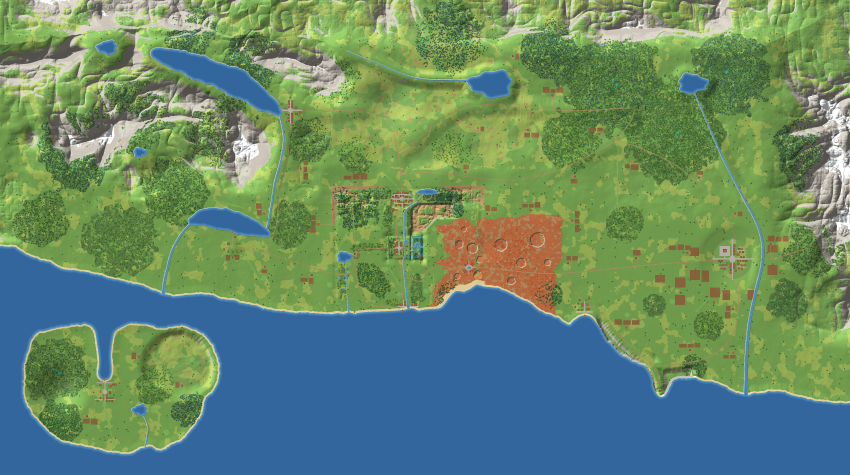 Open the world map
The regions
| Where | What's there |
|---|---|
| Highmarch (north, up the north road) | The big city on its plateau. The Kingsway and the Crossway meet in the Crown Square (fountain, market carts, Ned the crier). Bank, Pennywhistle's Market (Osric), Coalhand's Smithy (Brenna: up to steel), the Crown and Kettle (Mother Maud: food), a cooking range, the Margrave's garden with Ysolde the scholar, Sergeant Hale at the south gate. The Highmarch Fields and their windmill lie below the plateau. |
| Greyspire Highlands (north-west) | Mountains of pine, and ironbark on the heights. Wolves. The Nine Stones stand in a ring on a hill. Roads from Highmarch's west gate and from Fenwick. |
| Coldwater Tarn and the Thornspine (north-east) | A mountain lake (deep pools and shallows) where the Wend begins, an old forester's lodge, dark pine woods and wolves. Forest trolls roam the Thornspine peaks north of the Glimmerwood. Over the bridge from Highmarch's east gate. |
| Fenwick (west) | A fen village on the shore of the Reedmere, with a jetty, a bank, Reedfoot Stores (Dobbin) and a range. Widow Merrow watches the mist. Birch woods to the north; rats in the back fields; goblins at Bramble Camp south-east of the village. |
| The Mirelands (south-west) | A bog of black pools and crooked oaks over the bridge across the Reedwater, with a goblin band and a hermit's empty hut. |
| Saltmere (south, at the river mouth) | The harbour town. Harbour Row runs along the waterfront and over the Wend. A bank, Saltbreeze Sundries (Dorrit), Nessa's Fish and Tackle (sells harpoons and buys fish at a good price), the Gull and Anchor (Bart: food), a range, and two piers. Harbourmaster Corwin stands at the end of the long pier. The bay has shallows by the beach and deep water off the piers. The Shellstrand beach to the west has giant rats. |
| Hollin Wood (south-east, across Southbridge) | Oak and ashwood; a pair of forest trolls. |
| The Sunscar and Redwell (far east, along the Long Road from Southbridge) | Rust-red badlands with mesas and emberwood in the gullies. Sunscar jackals hunt in packs. Redwell is an oasis town round a spring: a bank, the Long Road Bazaar (Tavi), Redhammer's Forge (Orla: up to darksteel axes), a range, and Auntie Sefa, keeper of the spring. |
Roads link every town, with signposts where they meet. Crossings: Southbridge on the Wend south of Elderford, the bridge below the Tarn, the Saltmere bridge on Harbour Row, and the Reedwater bridge to the Mirelands.
Beyond the Wendlands
| Where | What's there |
|---|---|
| Cairnhold (north-west, about 700 m from Elderford) | A stone town on the shore of Mirrorwater, a long mountain lake, with the Greyspire Peaks standing over it like a wall. A bank (Hask), Cairnstone Provisions (Wenna: pays well for pelts and leather), the Cold Hearth inn (Fenna), Dunmore's Forge (wants darkstone and mithril), Tamsin's Tackle on the pier, Rook's Lodge (axes and bows), a garden and a notice board. Ilse the herbwife needs frostcap for a fever. Above the town, the Eagle's Seat looks out over the whole lake. |
| The Greyspire Peaks (north-west) | The big mountains: pine on the lower slopes, bare stone and snow above. Frostmere, a cold lake high up where frostcap grows; the dark Blackwater Tarn with its bog wights; wolves, and forest trolls on the heights. Iron, coal, darkstone, mithril and, far up, starmetal. The Frostmere Brow lookout. |
| Ashby and the Longmere (west, about 650 m) | A farming hamlet round a village green on a long, friendly lake: a bank (Odo), Millside Sundries (Hettie: pays well for iron and bones), Wil's Jetty, a forge in the open, a garden, Alder's windmill and Marigold's fields (and rats in them). The Westfells roll away to the west. |
| Harrowdown (north) | High heather moors. Goblins at Harrow Camp, ruined crofts, and the Old Watch, a broken signal tower on its hill, kept by Ansel the Watchman. North-east, Stillwater and the Watcher's Step lookout. |
| The Greenwold (north-east) | A great old forest of oak, ashwood and elderheart, with wolves and, to the north, forest trolls. Wold Water lies in its north. In its heart stand the roofless ruins of Wold Abbey, where Brother Imre keeps watch and moss golems wander the cloister. |
| Gullcliff (east, on the coast, about 770 m) | A harbour under white chalk cliffs: Harbour Row along the front and Up Street to the cliffs. A bank (Maren), Tallow's Chandlery (Gwyn: pays well for timber and sailcloth), the Rope and Lantern inn (Ewan), Brynn's Anvil, Sabine's Nets, a garden, a pier with rowing boats and Old Harl mending his net. Gullcliff Head looks out to sea. |
| Lantern Point (south-east of Gullcliff) | The lighthouse at the end of the chalk cliffs, red and white, its lamp lit every night by Tobias. Saltscale fishmen in the coves below. |
| Kingsbridge and the Crownlands (far east, about 1.3 km) | The royal city: eight walls and eight towers round a market square with a fountain, four gatehouses with portcullises, and the Keep in its walled ward, where Steward Harlan runs the city from the great hall. Two bankers (Osmund and Cressida), the Crownway Emporium (Beatrix: pays well for gems, jewellery and potions), the Crowned Swan inn (Rosalind), the King's Anvil (Gareth: pays well for plate armour), Quayside Tackle on the river quay, the King's Forester (Hob), a garden, Captain Edric and the city watch. Around it, the farms and windmills of the Crownlands (rats in the barns). |
| The Ashen Teeth (far east) | Grey, jagged mountains past Kingsbridge, with forest trolls. Below them the Ashen Quarry, where the city's stone was cut, has rich ore and moss golems in its pits. |
| The Isle of Morrow (south-west, by ferry) | A big island of heather and sheep across Morrow Sound. Morrowhaven has a bank (Ines), Moll's Island Stores (pays well for ore and bars), the Lamplit Net inn (Agnes), Hal's Forge, Callum's Fish and Tackle, a garden and Old Nell's stories. Inland, the Heather Stones ring on Heatherfell (bog wights after dark), the Morrow Tor lookout and Bell Pool. Down the south shore, the Drowned Halls: the arches of a town the sea took, standing in the surf, and the saltscale fishmen who live there. |
The ferry: Tess, at the end of the short pier in Saltmere, rows you over to Morrowhaven for 20 coins, and Lune brings you back.
Lookouts: benches on the best high spots, each with a view: the Eagle's Seat (over Mirrorwater), Frostmere Brow, the Watcher's Step, Gullcliff Head (to Lantern Point) and Morrow Tor.
Every town has a bank, a general store, a furnace and anvil, a tanning rack and spinning wheel, a garden and a notice board with its own requests; the bigger ones have an inn with a range, a smithy and a fishing hut. Every skill's resources turn up in several regions.
Elderford
The starting town, a river town of white plaster and dark timber around a cobbled square with a fountain (Edda the Woodcutter, who cleared the first trees). Three streets lead to its gates, and a fourth over the bridge.
- The square: the fountain, benches, a produce cart, the well and the notice board. New players arrive here.
- North side: the Bank of Elderford, the Sleeping Stag inn (Hilda, and the cooking range by its door) and Bram's forester's lodge by the west gate. Captain Aldric keeps the west gate.
- South side: Pip's Elderford Goods, Torva's forge (its furnace, anvil, tanning rack and spinning wheel in the smith's yard between the forge and the south gate, where Holt and Mira teach), cottages and townhouses, and Marla's fishing hut on the riverbank. The town's well stands on the green at the square's south-east corner.
- Street lanterns light up at dusk, each with a soft glow in the air round it that you can see from the next hill.
- Windows light up too. As the sun goes down the townsfolk light their lamps, window by window; most are dark again after midnight, a few early risers light theirs before dawn. On a day as dark as a storm's they're lit as well.
- Every building can be entered (the ground floor): the cottages (a hearth, a bed, a table and a dresser), the townhouses (a kitchen with stairs up), the shops, the inn and the bank (their keepers behind the counter) and Old Tom's windmill (the millstones under their hopper, sacks of flour).
- The town gates are stone arches under red tiled roofs, hung with the town's green banners.
The Vale of Elderford
- Windmill Hill (north-west): Old Tom's windmill, its fields and hay. Ashwood Ridge rises behind it.
- The Elder's Shrine (north): Elder Rowan's shrine on its knoll by the river, a little open temple of pale stone hung with moss, a basin of still water under its roof.
- Western Woods: pines, birches and oaks; the Goblin Thicket to the south-west and wolves in Oakmoor to the north-west.
- The river: three bridges: the north road's, the south bridge by the Elderheart's grove, and Southbridge on the south road. Angler's Pond lies north-east.
- Across the river: forest trolls in the Troll Fells, and the great Elderheart in its grove in the far south-east.
- Emberstone (south): rocks and glowing emberwood.
- The Glimmerwood (east, through the pass once the Elderheart is healed: until then a wall of thorny brambles fills it from cliff to cliff): glowing teal moss and grass, drifting motes of light, the Sunken Ruins, ironbark and emberwood groves, two more Elderhearts, trolls and moss golems. The Moonbrook runs out of the west cliff, through the Moonlit Mere and into the east cliff; Grubnak's Bridge is the only way over it (see Quests), to the Mere's far shore: its deep fishing pools, wolves, and the only starlilies near Elderford.
Walking into a named place shows its name at the top of the screen. The world map (M) names them all.
Worlds
The realm has five worlds, like RuneScape's. Each is its own copy of the land with its own trees (felled in one, standing in another), fires, ground items, shops' stock, trades and chat, and its own players. You are the same on all of them: one account, your characters, skills, bank, quests and crops come with you wherever you log in.
- Pick a world on the login screen (you see how many are online), or switch any time with O (Settings) then Switch world: you're saved, logged in on the other world and back in the game in a few seconds.
- You can be on one world at a time: logging in on another world (or a second computer) drops the first.
- World 1 is the builders' world: build mode (F6) works only there. The others have the same map, taken from World 1 when they restart.
- Friends and /w private messages reach across worlds, and the friends list shows which world a friend is on. Nearby, world and trade chat, trading and the weather stay on your world.
- A world can fill up; then it's greyed out in the list.
Out in the country
The land between the towns is lived in:
- Farmsteads (about thirty) stand along the roads in open country, each with its own name: a farmhouse facing the road with a dirt track down to it, an open hay barn, and a yard with a hen house, a trough, a woodpile, a wagon, beehives, crates or washing on a line. Behind them lie one to three fields of wheat, barley or young green crops in rows (or left fallow), walled in dry stone or hedged, each with a scarecrow and a haystack.
- Graveyards, walled, on the edge of every town (and an older one at Wold Abbey): rows of gravestones, crosses and tombs.
- Ravenhold, a ruined castle on a hilltop in the north-east, far from any town: four bastions, a gatehouse, stairs up to the wall walk (you can walk along the top), a breach in one wall, rubble where the hall stood and an abandoned camp in the courtyard.
- Goblin stockades: four goblin camps out in the wild (Snagtooth Camp and Muckwallow Camp among them) are ringed with sharpened stakes, broken in places, with a watchtower by the gate.
- Bandit camps lie off the roads: Cutpurse Hollow, Redcap Camp and Gallows Camp, each a fire and two tents with bandits round them.
- Watch forts guard the roads: Brackwater, Thornfield, Highgate and Ravensmoor Watch, square palisades with a watchtower and the realm's banner.
- Mines are dug into the hillsides by the ore sites, a cart of ore on the rails outside.
- Camps: woodcutters' in the forests, travellers' by the roads and hunters' up in the hills, each round a fire with a pot hung over it. The fires burn day and night: at dusk you see them glow from far off, with smoke rising.
- Along the roads: milestones, wayside shrines and the realm's banners at every town gate; cairns on the hilltops; training yards with dummies by Kingsbridge's keep and in Highmarch.
- On the shores: old wrecks on the beaches, and net racks by the towns at the water.
- In the woods: fallen logs and old stumps (you can jump onto them), and undergrowth everywhere: bushes heaped round the woods' edges and in thickets out in the open, ferns, mushrooms and fallen twigs under the trees, heather on the moors, lupins in the meadows, dry scrub on the Sunscar, pebbles on stony ground, reeds along the water and lily pads on still ponds. They sway in the wind and give way as you walk through.
- Smoke rises from the chimneys of the houses where someone's cooking.
On the roads
The roads between the towns are travelled (shared by everyone in a world: what you see on the road, others see too). It all happens around the players who are online: people and bands turn up near someone (out of sight round a bend, never in front of you), and once nobody has been near them for a little while (300 metres or more off), they go. Your maps only show the ones near you.
- Travellers walk from town to town: merchants, pilgrims, couriers in a hurry, wandering bards and farmhands. They follow the roads, rest a while in town and go on to the next one, and now and then they greet you as you pass. Talk to them for news of the road. There are always a couple about wherever you are on the roads.
- The wandering trader passes through now and then (about every half hour, somewhere near one of the players online, often far from any town). They sell what the town shops don't (rare herb seeds, uncut emeralds and rubies, gatherer's tonics, artisan's brews, iron studs, a harpoon) and pay better than any shop for gems, jewellery, potions and rare finds (pearls, starglass, a robin's egg, heartwood...). Right-click them to trade straight away. They're marked with the shop's coin on the map while they're about.
People in trouble turn up near you every few minutes (each player gets their own, unless someone near them is already in trouble). They have an orange "!" over their head and on the minimap and world map:
- A broken wagon: a merchant's axle has split. Bring two logs (any kind) and talk to them: you fit a new axle (a little Crafting XP) and they pay you for it.
- A hungry pilgrim faint by the road: give them something to eat (they take the plainest food in your pack).
- A lost child: they tell you which town they live in. Say follow me and they keep close behind you, running to catch up; walk them home (into the town) and their mother thanks you. Leave them far behind and they sit down to wait for you.
- Robbers on the road: footpads, bandits or brigands (tougher the stronger you are) set upon a traveller. You hear the shouts from a long way off (Shouts for help to the north-east...), the traveller's "!" turns red and their health shows over them. Kill every robber before they've beaten the traveller (about a minute and a half) and everyone who fought is thanked. Too late, and the traveller is robbed and runs off.
Bands out of the camps. The goblin and bandit camps don't sit still:
- Now and then (every few minutes while someone is within about 250 metres) a camp sends three bandits or four goblins out on patrol, marching in file along the roads near their camp or over to the next camp, then back home. A patrol that meets a traveller on the road sets upon them.
- Or they raid a farmstead near their camp: the farmer runs out at them, and if nobody comes, they carry off the grain. Kill the raiders to save the farm.
- They fight like any of their kind: they go for you if you come close, and their friends join in.
Ambushes. Walk the roads out of town (well away from the towns, at combat level 5 or more) and robbers may leap out at you from beside the road (Your purse or your life!): two footpads (level 6) at first, bandits once you're level 15, brigands (level 32) at level 30, and three brigands past 45. It doesn't happen often, and never again for a good few minutes.
What helping pays: coins (more for driving off tougher robbers), sometimes something from their pack (a merchant's linen thread or an uncut sapphire, a pilgrim's herb seeds or a vigour potion, a farmer's potatoes and pumpkins), and, 1 in 60 good deeds, a rare wayfarer's charm (a lucky horseshoe amulet, logged on the collection log's On the road page).
People going about their day
Townsfolk don't stand rooted to one spot any more: everyone with a trade has a day of their own, and you can watch it.
- They work. Innkeepers tend the bar, fetch from the kegs, wipe the tables, sweep the floor with a broom in the mornings and at night, and poke the hearth. Smiths hammer at the anvil and stoke the forge. The woodcutter chops at a tree (it shakes, chips fly), miners swing a pickaxe at a rock, anglers and fishers cast a line from the bank. Shopkeepers stock their shelves and write in the book, bankers bend over the ledger, cooks stir the pot, herbalists and farmers kneel in the beds and scatter feed, priests pray at the shrine, trainers strike the practice dummy, the crier calls out the news, guards walk their beat.
- They sit. On the benches in town, on the stools and chairs of inns and houses. Patrons of the inns read a book or drink from a tankard at their table; elders and children sit a while on a bench; they get up again when their day moves on.
- They walk. Between the counter, the back of the shop and the front door, between the forge and the anvil, across the square to a bench or a notice board, round the houses rather than through them. Everyone keeps near where they belong (a banker within a few metres of the counter, a woodcutter or a guard some twenty), and keepers spend a good part of the day by their counters.
- The time of day matters. Sweeping is for early and late, taking the air at the front door for daytime, warming hands at a fire for the evening and the night. When it rains, work out of doors that wants dry weather waits: people stay at their post.
- They say things now and then as they work ("Hot iron waits for nobody.").
- Talking and trading work wherever they are. Walk up to someone on their round and press E: they stop and turn to you, and stay put for as long as anyone talks to or trades with them (someone sitting stays seated). You no longer have to find them behind the counter.
- Everyone sees the same thing. Where each person is at any moment follows from the world's clock, so you and a friend standing in the same inn see Hilda at the same keg.
- No two people are given the same seat or the same place to work; if two strolls happen to end on one spot, the second person stops a step short.
Not everything yet: minimap dots stay where a person's post is; people don't chat with each other; logs and stumps aren't seats; a few people out in the country (two elders, two fishers) found no bench or water near enough and only stroll. Grubnak keeps to his bridge.
People standing about
Nobody stands the same way, and nobody moves in step.
- Stances. Everyone rests their weight on one leg, the other foot a little out, arms loose, breathing. Townsfolk each have their own way of standing, and keep it: plain (on the left or the right leg), a hand on the hip, hands behind the back, or hands held in front. Each also breathes and sways at their own pace, starting at their own moment.
- Fidgets. Every so often (5 to 18 seconds apart, different for everyone) someone standing does something: shifts their weight to the other leg with a small step, stretches, rubs their neck, looks at a hand, rolls their neck or sighs. Never the same thing twice in a row, and nothing that needs a hand that's holding something.
- Looking round. Heads glance off to one side now and then and come back. Townsfolk look at you when you come within about six metres, turning head and shoulders to follow you as you pass (not if you're behind them).
- Stopping. When you stop running your body carries on a touch over your feet and rocks back, then settles into the stance; the standing pose eases in rather than snapping on. Your own character fidgets and glances the same way when you leave them be.
Faces
Every human (you, other players, townsfolk, travellers, bandits) has a face that moves. It's drawn fresh over the skin colour you picked, so it looks the same clean way on every skin tone.
- Blinking. Everyone blinks in their own time, now and then twice in a row.
- Talking. Say something in local chat and your mouth moves through the line: open for an a, round for an o or u, shut for m, b and p, a pause between words. Townsfolk do the same while their line is up when you talk to them, and so do travellers and bandits when they call out.
- Smileys change your face. What you type shows for as long as you speak and a couple of seconds after:
| You type | Your face |
|---|---|
:) =) :3 :p, "thanks", "nice" |
a smile, brows up |
:D xD ^^, "haha", "lol", "yay", "gz" |
eyes shut in a laugh, a grin |
:( :/ T_T, "sorry", "rip" |
heavy lids, brows up in the middle, a frown |
>:(, "grr" |
brows down, a frown |
:o o_o ?!, "wow", "omg" |
wide eyes, a round mouth |
;) ;p |
a wink |
| "zzz" | sleepy lids |
- In a fight the brows come down and the mouth sets. Hit, you wince for a moment (eyes screwed shut, teeth gritted).
- A level gained: three seconds of joy.
- Townsfolk smile at you while they look at you as you pass.
- Brows are your hair colour.
Choosing your face
Character creation has two rows for it, under the hairstyles:
| Face | What it looks like |
|---|---|
| Bright | Big open eyes with a thick upper lash line and a flick; the face everyone starts with. |
| Classic | The bodies' first faces, traced off their old paint and drawn clean. The woman's: a thick flat lid with two tufts of lashes on it, the eye hanging under it, a big dark iris, three lashes fanned out below, thick brows that peak towards the outside, a small mouth set low. The man's: almond eyes under a peaked lid with a wing flicking out, a big tall iris, two short lashes under each eye, long thin brows. |
| Gentle | Soft eyes, the lid resting on the iris and the outer corners falling a little: calm and kind. |
| Sharp | Narrow eyes slanting up to a long flick, straight brows: keen. |
Every face blinks, talks and shows the same expressions.
Eyes picks the colour: blue, green, brown, amber, grey-blue, violet, dark brown, teal, grey or rose. Until you pick one, you have the colour that goes with your skin and hair, as before. (The woman's Classic iris is a dark disc that only hints at the colour.)
Changing it later: on the character list, Change look opens the same screen for a character you already have: body, skin, hair, hairstyle, face, eyes and the body sliders (see Your character, Your body), free, as often as you like. Not while that character is in the world.
Goblins, trolls, fishmen and wights keep their own painted faces.
Walking, running and sprinting
How everyone on two legs moves: you, other players, townsfolk, travellers, goblins, trolls, fishmen and wights.
- Walking is an easy stroll: heel down first, the foot rolling to the toes, the hips riding up over the standing leg and dropping on the loose side, the pelvis turning with the leg that reaches and the shoulders the other way, the arms hanging loose and swinging from the shoulder with the forearm trailing a moment behind.
- Jogging is the pace between a walk and a run: short springy steps, elbows bent, fists low. It's what you drop to when you're out of breath, and what anyone going about 3 metres a second does.
- Running (how you get about) is light and springy: a clear float between steps, the body sinking a little into each landing and pushed up off the toes, the heel kicked up behind and the knee carried through. The whole trunk works with the legs: the pelvis turns into each stride, the shoulders wind the other way, the hips sway over the landing foot, the chest folds a little into each landing and opens in the air, and the head stays level over it all. The arms swing from the shoulder with elbows that open behind and close in front, fists coming up to the chest and back past the hip.
- Sprinting (Shift) throws all of that forward: a deep lean, long strides landing on the ball of the foot, the arms pumping from chin to hip.
- Sideways and backwards (locked on to an enemy, see Combat): the body keeps facing the enemy while the legs go where you go. Sideways and on the slant it is the same run with the hips turned to the way you travel and the back, chest and head wound round to the enemy; going away from it the legs back-pedal: short low steps reaching back onto the toes, knees bent, the trunk tipped a little forward, arms tucked (and a slow backwards walk with Ctrl). Change from sideways to backing off and the legs flip round within a stride.
- Leaning into turns. Turn while you run and the whole figure leans into the bend from the feet, the back curving a little further and the head looking where you're headed; the faster you go round, the deeper the lean. Straighten out and you come upright again.
- Your body has weight. You no longer reach full speed or stand still in a single instant: the body takes a moment to get going and carries on a little when you let go of the keys.
- Setting off: you're at a run about a seventh of a second after pressing the key (a sprint takes a little longer), thrown forward off the mark, and the first stride starts on the leg your weight was on with the other one stepping out. The legs go straight into the run rather than through a walk and a jog first.
- Stopping out of a run (the everyday pace) is a short braking stop: the foot that was coming forward is planted ahead of you heel first, the other takes one short step and props you from behind, your knees give a little and your trunk leans back a touch against the speed, and then your weight comes up over the front foot and you straighten into standing. You come to rest about 40 cm past where you let go (a fifth of a second). It was a much bigger move until 2026-11-20 (a deep crouch with the arms out wide): you found that over the top for a pace you stop from all the time, so the big move is now only the sprint's.
- Stopping out of a sprint is a skid: the leading foot is thrown out far ahead with the heel dug in and slides, the other leg folds under you, you lie back with your arms flung wide, and you slide about a metre before you rise out of it. The heel throws up dust on paths, sand and bare earth (spray in the rain), and you hear it scrape (a swish through grass).
- Out of a jog (out of breath) you're caught on the foot under you as before, and a walk simply stops: there's no speed to brake.
- Turning: steering with the camera loses nothing. A sharp turn on the keys drifts a hand's width wide and costs a little speed. Asking for the opposite way while running is a brake first, then the turn and a fresh start.
- Landing from a jump takes most of your speed out of your legs if you let go of the keys in the air, so you stop about where you land (a post, a ledge); keep a direction held and you run on, and the first step after landing goes exactly where you point.
- Other players, townsfolk and enemies stop as before (caught on the foot under them): the game only knows how your own keys are held.
- Hills. Uphill you lean into the slope; downhill you sit back a little.
- Out of breath (stamina spent) you jog on bent forward with your head hanging, and stand panting until you've got your wind back.
- Feet stay where they're put. A foot on the ground holds its spot while the body passes over it; the stride keeps pace with how fast you're actually going. Dust rises exactly where and when a running foot lands.
- Footsteps. Every foot that comes down is heard, and it sounds like what it lands on: a soft thud in grass, a dry one on a dirt path, a hard tap on cobbles and rock, a hiss in sand, a crunch in snow, a thud in crackling leaves on the forest floor, a hollow knock on floorboards and bridge planks (flagstones in the smithy and the keep). In the rain, and for a while after it on wet ground, there's a splash in each step. A walk treads softly, a run firmly, a sprint lands hard; landing from a jump or a fall thumps on the same ground. A troll's feet are low and heavy, a goblin's quick and light, and the two bodies differ a little. Others' steps come from where they are and fade with distance: a runner is heard from about 22 metres, someone walking from half that. Their volume is the Footsteps slider in Settings (O).
- Walking by choice. Ctrl switches you to a stroll and back to a run (see Getting started).
- Something in your hand (a drawn sword, an axe just after chopping, a lantern): that arm is carried low at your side instead of swinging, so the blade isn't waved about.
- Changing pace (walk to jog to run to sprint, drawing a sword on the run) carries the stride on with the same foot coming down, instead of starting the step over.
- Everyone moves in their own way. Body A runs with square shoulders and quiet hips; body B's hips sway more, her feet land nearer one line and her heels flick up. A goblin scuttles low and bent forward on quick short steps with its elbows out, a troll lumbers wide and heavy, a fishman paddles along, a wight goes stiff and bowed with its arms barely swinging. Everyone's stride fits their own legs.
- The keys still answer at once: the body starts speeding up, braking or turning in the very frame you press or let go. What changed (2026-11-19) is that it then takes that short moment to get there, as a body would.
- Skirts, dresses, robes, coat tails, aprons and capes are cloth, and cloth is laid over the body before it swings. Every strip of a skirt hangs from the waist (a cape's from the shoulders) and is walked down link by link: wherever a thigh, a knee, a shin, a shoe, the seat or the back is in the way, that link is turned outward just far enough to lie on it. So there is always a place for the cloth that is outside the body, and a leg can't come through it: not at a sprint, not on a full build, not from far off. Standing, a garment lies exactly as it was tailored (it is never pushed off the body it was cut for). Between a lifted knee and the rest of the skirt the cloth spans like a tent, no wider than the cloth really is. Then it swings: it lags a moment when you start, stop or turn, a wave runs down to the hem, and it settles round you instead of streaming out like a flag; whatever the swing does, it is laid over the legs again before you see it. A skirt hangs straight down from the waist however far you lean into a sprint, and the back of a dress stays over the seat. A short skirt keeps its shape at a sprint as well: with the thigh coming up level under it, its sides and back used to jump out for a frame every stride. Capes hang down the back, lie over the seat and over whatever skirt is worn under them, lean back on the air when you run and ripple a little, and come to rest when you stand. Cloth over cloth: a cape over a tunic's skirt, a dress over a long skirt, a coat over a kilt: the outer one stays outside the inner one. Far away (15 to 40 m) cloth is still laid over the legs, only not swung, so skirts don't clip in a crowd either; cloth on someone standing still is left as it lies, which is why a town full of skirts costs nothing to draw. In a skirt you run as people do in skirts: in anything that reaches the knee the stride is shorter and lower (the heels don't kick up behind, the knees don't come up to the hips), more so the longer it is; kilts, tunics and short dresses leave the stride as it is.
- Clothes fit the body they're on. They follow the body's own shape (over the hips and seat, round the shoulders) rather than a thicker invisible one, and lie on it: a piece only widens for what you're really wearing under it (a dress over bare legs hugs the hips; the same dress over plate legs makes room for them). A dress no longer goes over the backpack, and pouches, straps and other things on the body itself don't show as bumps through what's worn over them. A garment under another one is hidden wherever the outer one covers it, so an inner layer never pokes out through an outer one.
- Movement is smooth by default. F5 (or Animate on twos in Settings) switches to the choppier anime look, which shows a new pose 12 times a second.
Animals
- Sheep graze by half the farms' barns, and cows by the others. The cows can be fought (level 2, they never start it): each drops raw beef (cook it from Cooking level 5), a cowhide (tan it into leather at a tanning rack, like a wolf pelt) and bones, and very rarely a Drover's bell amulet; flocks of sheep and rabbits live out in the open country, deer and foxes along the edges of the woods (and deer in the Glimmerwood).
- They graze with their heads down, look up now and then, wander after the herd, and their lambs and calves keep close. Come too near and they bolt, the whole flock or herd with them, stopping further off to look back. Deer are the shyest (they're off when you're 18 metres away); sheep let you come within about 5 metres, and cows just step aside. Sheep bleat and cows low now and then.
- They're part of the scenery: they can't be hunted (yet), and every player sees their own herds.
- In the air: crows wheel over the woods, gulls over the lakes and the sea (crying as they go), and swallows swoop low over the meadows. By day butterflies (white, yellow, orange and blue) flutter over meadows, gardens and fields; at night fireflies blink in the grass. In the rain they all keep out of sight.
- What drifts by: every kind of country has its own air. Under the trees leaves fall from the crowns overhead (in their colour, some turned yellow), tumbling and slipping sideways on the wind. Over the meadows dandelion fluff sails by and now and then a petal is tossed up off the flowers. On the snowfields it snows. Over the Sunscar's red earth and on the beaches wisps of sand race low along the ground whenever a gust passes. And at dawn mist lies on the rivers and lakes, thinning as the sun climbs (a little of it hangs there all night, and in fog).
- What you kick up: running and sprinting raise puffs of dust off dry ground (roads, sand, red earth, farmland, cobbles, snow as powder; not off grass or floors), a jump leaves a puff where you stood, a landing throws dust out in a ring (the harder the fall, the more), and sliding down a slope trails it. Landing in water throws up a crown of drops, spray and rings running out. Axes knock wood chips off a trunk, pickaxes stone chips and a few sparks off a rock, and the hammer sparks off the anvil (more on the beat). In the rain every drop spatters on the ground and rings the water, and wet feet splash instead of raising dust. Smoke from chimneys, ranges, furnaces and camp fires rises in round puffs that swell and thin out. Everyone you see kicks up the same.
- Mirrored light: the sun lays a road of glitter on the water towards it, and at night the moon does the same, twinkling as the ripples pass. After dark every lantern, lit window and fire by the water is drawn out into a long broken streak of light on it. After rain, puddles stand on the roads, the cobbles, the fields and bare stone: they fill while it rains and dry out over a few minutes, shrinking as they go. A puddle mirrors the sky (and the very clouds drifting over it), turns gold at sunset, catches the sun or the moon as a glint, and at night wet streets carry the lanterns' light as warm streaks. And far-off houses, towers and crags now cast their shadows on the ground, turning with the sun, so a distant town sits on the land instead of floating over it.
Day, night and weather
A day lasts 30 minutes and is the same for everyone. The sun rises in the east and sets in a warm, orange sky; nights are blue and moonlit (colours fade to blue-grey in the moonlight, and only what a lamp or fire lights keeps its warmth), with stars, lit lanterns and windows, and crickets. The weather changes every few minutes: mostly fair, sometimes cloudy, sometimes rain (it darkens the sky, wets the ground and rings the water with raindrops), and now and then a morning fog in the valley. The wind picks up in bad weather: watch the grass, and the white streaks of wind that curl past you.
Realm events
Now and then something comes over a world, and the realm hears of it (the chat says which world), so it's worth hopping to:
- Thunderstorms: a rarer, darker rain. The sky goes slate grey, lightning flashes it white and thunder rolls a moment later. Crops growing through one may come out Shocked (x3 value, see Farming). Only that world hears of a storm.
- The Harvest Moon: some nights a big amber moon rises. Until morning crops grow twice as fast and may come out Moonblessed.
- The Blood Moon: some nights the moon rises red and the night with it. Until morning enemies hit a fifth harder, but their finds (uncommon and rarer drops) come twice as often; crops may come out Bloodmoon.
- Starfall: about once an hour on each world a shooting star is foretold near a named place, out in open country. It shows on the map and minimap (faded while it's still falling); two and a half minutes later it streaks down out of the sky and crashes. Anyone can mine it, at any Mining level, for stardust (sprinkle it on a growing crop for a chance of Starlit, x6), and very rarely a lump of starmetal ore. The more players on the world, the more dust in it; it's gone when it's mined out, or after twenty minutes.
Grass and flowers
The grass is drawn blade by blade, cel-shaded like the characters, in the style of Breath of the Wild and Genshin Impact: every tuft is a clump of broad, soft, curving blades, the inner ones taller and the outer ones curving out a little. Wild grass stands about knee high, meadow grass a little taller. The earth between the tufts is the green of their roots, so a field is one soft carpet, deeper green low down and light at the tips, with no dark holes in it. Looked at towards the sun, a field glows: the light comes through the blades. A field is lit as one surface, in sun or in crisp-edged shadow (trees, houses and people cast clean shadows across it), and coloured by height: dark and cool deep down, a deep green body and light tops, with a bright band at each blade's tip. Against the sun the tips glow as the light shines through them. Neighbouring tufts sway together in the wind and golden gusts roll across the fields.
Walking through grass parts it round your legs and presses it down the way you're going. The trodden grass stays down for a moment and then rises again over a few seconds, so you can see the path you, other players, townsfolk and creatures have just made through a meadow. Further off, the blades settle into one soft carpet.
What grows depends on the ground: short, tended grass on lawns, taller grass in meadows, golden in broad drifts, tufts over moss and drifts of fallen leaves on the forest floor and silvery teal grass in the Glimmerwood. Wildflowers grow in drifts of one kind: white and pink daisies, glossy yellow buttercups, arching violet-blue bellflowers and red poppies. A meadow has carpets of them in some places and only a few strays in others, and out in the wild grass you now and then walk into a drift as thick as a meadow's. On the high moors heather grows in purple cushions. The Glimmerwood's pale blue bells and white daisies glow faintly.
Trees and rock
A tree's crown is lit as one rounded shape, the way trees are painted in Breath of the Wild or a HoYoverse game: the sun's side bright, its sunniest shoulder a touch warmer, the far side and the underside a cool blue-green, lighter towards the top and deeper underneath. The leaves themselves are soft bunches lying over each other, in a few close tones. No two trees are quite the same green: each has its own tone (a little warmer or cooler, paler or deeper), and whole woods lean one way together, so a forest is a patchwork instead of one flat colour. Oaks are a rich green, birches a bright yellow-green, ashwoods sage, ironbarks teal, emberwoods orange and the Elderheart sea-green.
Rock lies in beds. Crags, boulders and ore rocks are pale stone in layers of uneven thickness, each layer a tone of its own, lit along its top edge. And ground too steep to walk up is bare rock of the same kind: where you'd slide back down, the hillside is a cliff's face, so you can read from a distance where you can climb and where you can't, and the crags along a ridge rise out of rock instead of standing on grass. Slope and crag share their tones and their shade, so a ridge is one mass of stone from its foot to its teeth. Mountainsides are the same pale stone, in warm and cool patches.
Shade is a colour, not darkness. A shadow on the ground or across a field is a cool blue, light enough that you still see everything in it; the shaded side of a house or a rock is a soft violet-grey. The sunlit and the shaded world share one light.
How far you can see
To the horizon: about 2.6 kilometres. From a hill above Elderford you see the Greyspire's peaks in the north, the Isle of Morrow out at sea and the walls of the next town; from the Crownlands, Kingsbridge under the snow of the Ashen Teeth. The air is clear near you and pales into a light blue haze with distance (about half at 600 metres, most of it by 1.5 kilometres), so far mountains stand as soft blue shapes and the land's last edge melts into the sky. The sea runs on to the horizon, and far lakes glint in their valleys.
The realm doesn't end at the map's edge. Past the last places you can walk the land rolls on into wild hills and snow-capped mountains (or open sea, where the edge is sea). You can't go there: it's the rim of the world.
Up close, everything is drawn in full detail, with shadows. The sun crosses the sky all day (a day lasts half an hour), so shadows creep round as you watch, but their edges stay steady: they don't shimmer or flicker, standing still or on the move. From about 45 metres trees, houses, walls and crags hand over to simpler far versions of exactly the same shape: the near one dissolves with a soft dither and the far one stands right behind it, so nothing appears, vanishes or changes shape. Trees and buildings are drawn out to 600 metres; beyond that, woods carry on as the dark of their crowns painted on the land, in each wood's own colour (the Sunscar's emberwoods stay red), and the land itself goes on to the horizon.
Grass grows thick around you and thins out gradually, tuft by tuft, with the tufts left standing growing wider, so a field never ends in a ring around you. It reaches about 190 metres. Beyond that the land is painted as the same grass seen from afar: the same greens, broad swathes of deep green and paler, drier grass, gusts rolling over it, and darker when you look down on it from a hill (you see the shade between the tufts). Hills are lit a little more where they face the sun, so they keep their shape. Far trees cast shadows too, beyond the sun's own shadows close by: soft ones that swing round with the sun through the day. People and creatures fade out at about 70 metres.
The sky
Clouds are real things over the world. Puffy cumulus in three tones (sunlit rims, a soft middle, cool blue shade), drifting with the wind. They hang over the land, not round your head: walk and the clouds overhead slide by. And they cast shadows: the cloud you see above the meadow is the one whose shadow crosses it, so a wide view is dappled with light and shade that moves. More clouds on a cloudy day, a grey ceiling in rain. At dusk they turn gold and rose, at night dark blue against the stars.
Banks of cloud stand along the horizon: great heaps of cumulus far beyond the clouds overhead, rising behind the mountains and over the sea, their tops sunlit and their feet melting into the haze. They glow where the sun is, turn rose and gold at dusk, and are dark shapes against the stars at night. Thin feathers of high cloud drift above everything.
Bright things glow. Sunlit clouds and white walls, the sun's glitter on water, and at night every lit window, lantern and fire have a soft glow round them that spills a little over what's beside them.
Sunlight
The sun shines through things. Stand in a wood in the morning or evening and look towards the sun: its light bursts through the canopy and streams out past trunks and crowns across your view, the leaves between you and the sun glow with the light coming through them, and the haze in that direction turns warm. Under the trees shafts of light slant down to the ground wherever the sun finds a gap between crowns: long and low early and late, steep at noon, turning with the sun through the day. The wood's floor is dappled: flecks of sunlight in the shade that shift as the wind moves the crowns, and the grass standing in one lights up.
A passing cloud's shadow puts the shafts out for a moment; an overcast sky, rain and fog put them out altogether. On a clear night the moon throws faint ones.
The light changes through the day. With the sun high it is nearly white: midday is crisp, the greens green and the walls white. Through the morning and the afternoon it turns gold, and towards sunrise and sunset orange, with the sky warming along the horizon well before the sun reaches it. The golden hours last longer than they did.
Sound
Quiet music comes and goes like in Breath of the Wild: a piece for the day, one for the night and one for the Glimmerwood, with silence between. Birds by day, crickets by night, the river as you near it, rain, crackling fires (the camps' too), sheep bleating and cows lowing by the farms, gulls crying over the water, the bite of an axe, and footsteps on whatever is underfoot (see Walking, running and sprinting above). Volumes are in Settings (O).